Independent build & consulting work · Remote, on AU/US hours

Build and ship fast, in ways you didn't think were possible.

Operations platforms · Real-time dashboards · Integrations & SSO · Migrations · Automation

That isn't a growth claim. It's what AI-assisted delivery does to a schedule when a senior engineer is holding the review. The model takes the scaffolding, the transformation grunt work, and the first draft of the tests. I keep the architecture, the data model, the security boundaries, and the judgment about what not to build at all. Twelve years of production systems across a national grid operator, a government audit commission, and remote teams in Australia and the US is what sits between that and vibe coding.

function engagement(problem) {
  const real = traceToConstraint(problem);
  // the brief is rarely the problem

  return build({
    scope:    'smallest thing that holds',
    owner:    'your team, not me',
    handover: 'still running in year three'
  }, real);
}

Where the Speed Comes From

The honest answer is that AI writes a significant share of the code. That's also the answer that should make you cautious, because the same tools are producing a great deal of software that demos beautifully in week one and becomes somebody's problem in month three. The tool isn't the variable. Who is holding the review is. I work in Codex and Claude Code daily, with n8n for the workflow automation around them.

Vibe coding

  • Ships the first version that runs
  • Prompts again until the error message goes away
  • Architecture is whatever the model proposed first
  • Auth, permissions, and schema generated like everything else
  • Tests written by the same model, against its own assumptions
  • Nobody can explain the system, including whoever shipped it
  • Fast in week one; the drag arrives in month three

Twelve years of production systems, with AI in the loop

  • Ships what I'd defend line by line in your code review
  • Fixes the cause, because I know why the error was there
  • Architecture and boundaries decided before a prompt is written
  • Security boundaries and data models written by hand, deliberately
  • Tests written against business rules a human decided on
  • A handover document, because every decision has a stated reason
  • Fast where speed is free: scaffolding, migrations, glue, first drafts

In calendar terms: scaffolding, wiring, transformation code, first-draft tests and documentation used to eat weeks and now take days. The parts that decide whether the system survives take exactly as long as they always did. The data model, the boundaries, what happens when it fails. That is the part you are actually paying for. Net effect, work that would once have been quoted in quarters gets quoted in weeks, against the same review bar and the same handover.

Where I let it drive

  • Scaffolding and the repetitive middle of a feature
  • Migration and transformation grunt work with a spec I can check against
  • Test cases around business rules I've already decided
  • Getting oriented in an unfamiliar API or an inherited codebase
  • First-draft docs, changelogs, and review notes

Where I don't

  • Architecture and system boundaries, which is the judgment you're paying for
  • Authentication, authorization, and anything holding a security boundary
  • Data models, which are expensive to get wrong and cheap to think about
  • Anything I couldn't review line by line and defend to your team

How I keep it honest

  • Generated code goes through the same review bar as written code
  • Business context and constraints go in up front, not corrections afterwards
  • Tests and reconciliation checks are the guardrail, not vibes
  • A human approves anything that writes to production data
  • If I can't explain why it works, it doesn't ship

In practice

At NGCP I use n8n, Codex, and Claude Code to take repetitive process work out of the delivery loop, the kind of steps too small to staff and too frequent to keep doing by hand, while keeping approval points human where the outcome matters. ROOC was built this way end to end, and so was the career game further down this page: AI accelerating the parts I'd already decided, with me holding the design and the review. The bill for that speed shows up as more of your budget spent on the decisions and less on the typing.

What I Build

Five things I get hired for. Each one is a problem I've solved more than once, in more than one industry. The case studies further down are the receipts.

01

Operations platforms that replace the spreadsheet

A process your business depends on is running on a shared sheet, a chat thread, and two people's memory. I turn it into software without turning it into bureaucracy.

You need this when

  • Nobody can say who changed what, or when
  • The rules live in etiquette rather than in the system
  • Onboarding somebody means explaining a workaround
  • One person leaving would genuinely hurt

What you get

  • Roles and permissions that mean something
  • An append-only history of every meaningful change
  • The workflow's states written down and enforced
  • Deployed somewhere nobody has to keep alive
Proof: ROOC and the Comtrac casework platform
02

Real-time dashboards people actually trust

Most dashboards fail quietly: the numbers go stale, somebody notices once, and the team drifts back to the raw feed. I treat freshness as an acceptance criterion rather than a performance target.

You need this when

  • A decision waits on a manual cross-check between systems
  • A number is on screen and nobody knows how old it is
  • Two teams quote different figures for the same thing
  • People have quietly started going around the dashboard

What you get

  • An aggregation layer that pulls sources onto one clock
  • Every figure shown with how stale it is
  • Alerts when a feed stops, before a user finds out
  • A panel that announces it's stale instead of lying
Proof: the NGCP five-minute grid & market dashboard
03

Integrations and single sign-on

Systems that won't talk, and a login screen for every one of them. The fix has to work without a rewrite, because the apps are live and owned by people with their own schedules.

You need this when

  • Every internal app has its own users table
  • Offboarding is a scavenger hunt across systems
  • Data moves between tools by export and import
  • An auditor asks who still has access to what

What you get

  • An identity layer your apps adopt one at a time
  • The old login still working the day before each switch
  • Service-to-service data flows with retries and a record
  • Access as one revocable thing per person
Proof: NGCP single sign-on and the Market Data Interchange
04

Legacy modernization and data migration

The database everyone agrees should move and nobody wants to be the one who moves it. What unblocks it isn't the transform. It's being able to prove the new system matches the old one before anybody commits.

You need this when

  • Licence cost on a platform nobody is hiring for
  • The people who understand it are down to a handful
  • The migration has been deferred more than once
  • A failed cutover would be a very bad weekend

What you get

  • A repeatable pipeline, not a one-off script
  • Reconciliation on counts, keys, and business totals
  • Old and new running side by side before you commit
  • Disagreements surfacing as findings, not as incidents
Proof: an aging Oracle estate moved onto PostgreSQL
05

Workflow automation, with AI where it earns it

The steps that are too small to staff and too frequent to keep doing by hand. I automate those, and keep a human at the points where being wrong is expensive.

You need this when

  • Somebody assembles the same report every week
  • Work moves between tools by copy and paste
  • A process stalls whenever one person is on leave
  • You want AI in the loop without losing the audit trail

What you get

  • Automations in n8n or plain code, whichever you can maintain
  • Human approval kept where the outcome matters
  • A log of what ran, what it changed, and what failed
  • AI where it's genuinely faster, with the review bar unchanged
Proof: how I actually use AI in delivery

How We'd Work Together

Three ways in, depending on how well-defined the problem already is. All of them start with the same conversation, and none of them start with a proposal I wrote before we had it.

True in every engagement

  • You own everything. Code, infrastructure, accounts, and domains in your name. Nothing hosted on something I control, no licence back to me.
  • Written handover. The architecture, the decisions and why they went that way, how to run it and how to change it. Written for the next person, not for me.
  • Scope agreed before we start. When something falls outside it you'll hear so, rather than have it quietly absorbed and resurface as a delay.
  • An honest no. If you don't need what you think you need, or need someone other than me, that's the first conversation, not the third invoice.
  • Remote, on your hours. Based in the Philippines, working to Australian and US schedules for years now. Overlap is a calendar question, not a risk.

Proof It Works

The same five systems the services above are built on, written up the way I'd talk you through them: what was broken, what the real constraint turned out to be, and what I built once I knew the difference. No logos wall. The detail is the point.

Side project · Live

ROOC Guild Management

Visit the app

The problem

A game guild was running loot auctions, member rosters, and reward payouts out of chat threads and a shared spreadsheet. Every contested item turned into an argument nobody could settle, because there was no record of who changed what, or which rule was in force when the change happened.

The real constraint

It looked like a tracking problem. It was a trust problem. A tool that let an administrator quietly edit history would have been abandoned inside a week, so the audit trail wasn't a feature to add later. It was the thing the whole design had to be built around.

What I built

Auction runs that carry their rules from the moment they open and move through a fixed lifecycle (open, awaiting result, finalized), so an assignment stops being editable once it's settled. Around that: a roster with a capacity, a reward catalog tied to rank bands, role-based access from Super Admin down, and an append-only history of every meaningful change. On Cloudflare Workers, so there's no server for a volunteer admin to keep alive.

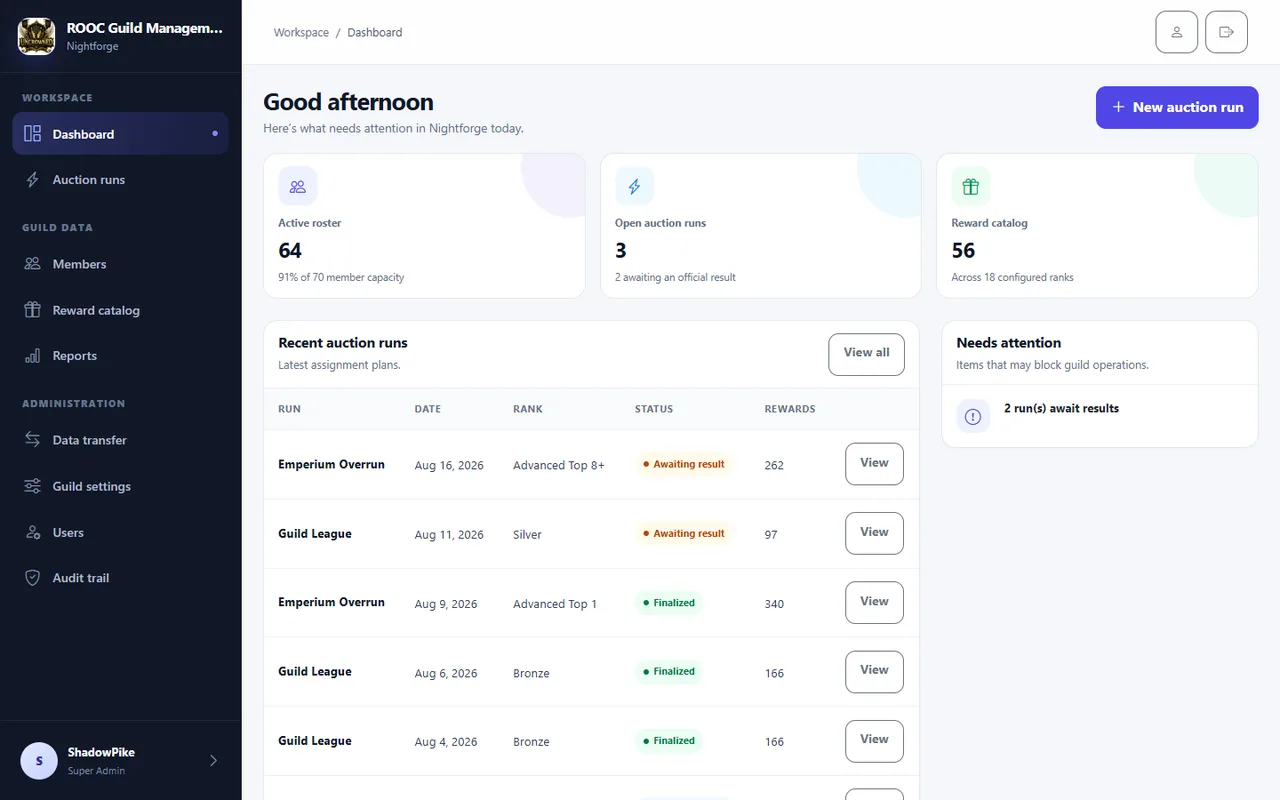
ROOC dashboard: roster, open auction runs and reward catalog totals across the top, a table of recent auction runs with their status, and panels for items needing attention and guild leadership.
The dashboard opens on what's unresolved rather than on totals. Runs awaiting an official result are what actually blocks a guild. Names and figures shown are sample data.

Outcome Contested assignments now get settled by pointing at the log instead of re-arguing them. Onboarding an officer is one role change rather than a conversation about who to trust with the spreadsheet.

Cloudflare Workers SPA Role-based access Append-only audit log AI-assisted build

Energy · National Grid Corporation of the Philippines

Real-time grid & market operations dashboard

The problem

Operators were reconciling SCADA telemetry against the electricity market's five-minute settlement intervals by hand, reading raw feeds in one place, market figures in another, and holding the comparison in their heads while decisions were already due.

The real constraint

The data arrives on the market's clock, not the user's. A dashboard that's even a minute stale is worse than no dashboard, because people quietly stop trusting it and go back to the raw feed. Freshness wasn't a performance target. It was the acceptance criterion.

What I built

I led Project Sentinel and the 5-Minute Real-Time Dashboard: an aggregation layer that pulls SCADA and market data onto the settlement interval, and a front end that shows the current interval, its inputs, and how stale each number is, so an operator can tell at a glance whether to trust what they're looking at.

Outcome The manual cross-check disappeared from the operators' interval routine, and the dashboard became the reference both operations and market interface teams worked from.

Laravel Vue.js 2 Node.js Oracle DB MongoDB SCADA

Enterprise identity · NGCP

Single sign-on across a fleet of internal apps

The problem

Years of internal micro-apps had accumulated, each with its own login screen and its own user table. Onboarding somebody meant touching every app; offboarding meant remembering to. Nobody could answer the audit question: who still has access to what?

The real constraint

A clean rewrite was never on the table. The apps were live, owned by different teams, and written across different stacks and eras. So the design had to let apps migrate one at a time, on their owner's schedule, with the old login still working the day before they switched.

What I built

A central sign-on service the apps could adopt incrementally, plus the Market Data Interchange that moved data between systems on the same identity model, so access questions and data-flow questions finally had one answer each instead of a dozen.

Outcome Access became a single revocable thing per person rather than a scavenger hunt across apps, and new internal tools started from an identity layer instead of building another login.

Laravel Node.js Vue.js Oracle DB MongoDB SSO

Data platform · Legacy modernization

Getting business systems off aging Oracle

The problem

Core business data sat in an aging Oracle estate carrying licence cost and a shrinking pool of people who understood it. Everyone agreed it should move. Nobody wanted to be the one who moved it.

The real constraint

The business doesn't pause while you migrate, and a cutover that silently loses a day of records is a failed cutover even if every row copied. The hard requirement wasn't the transform. It was being able to prove the new database matched the old one before anybody committed to it.

What I built

A migration pipeline that transformed legacy Oracle structures into a PostgreSQL model and reconciled the result on counts, keys, and business totals, so the two systems could run side by side and disagreements surfaced as findings instead of as production incidents after the switch.

Outcome The migration became a reviewable, repeatable process rather than a single high-stakes weekend, which is what made it safe enough to actually do.

Python Oracle PostgreSQL Node.js ETL & reconciliation

Investigation software · Comtrac, via GoTeam

A casework platform where the audit trail is the product

The problem

An investigation management platform where evidence handling has to stand up to scrutiny later: who saw what, when, and what changed. Casework is written slowly and carefully, but read constantly, from many angles, by people who need an answer now.

The real constraint

Reads and writes had almost nothing in common. Writes needed to be strict, validated, and permanently recorded; reads needed to be fast and shaped around whatever question an investigator was asking. Forcing both through one model was making each of them worse.

What I built

I worked on the platform's move toward a CQRS architecture, separating the write path from purpose-built read models, and delivered features against it in Vue 3 and .NET, alongside the ongoing maintenance the product needed to stay stable for live investigations.

Outcome Query-shaped features stopped forcing changes to the write model, so new views could be added without putting the integrity of existing case records at risk.

Vue.js 3 Composition API C# / .NET CQRS Azure CI/CD

How an Engagement Actually Runs

The pattern under every case study above, and what the first weeks of working together look like. It isn't a methodology I'm selling. It's what stops me building the wrong thing well, on your budget.

01

Watch the work, not the brief

A brief is a symptom somebody already interpreted for me. I go and see how the work actually moves through your business, including the workaround your people invented and stopped mentioning, which is usually where the real requirement is hiding.

02

Find the one thing that's binding

Most problems have one constraint doing the damage and a crowd of symptoms around it. Trust, freshness, an unmovable legacy system, a schedule nobody controls. Naming it changes what's worth paying for, and rules out most of the obvious answers, usually including the expensive one you were about to buy.

03

Build the smallest thing that holds

Something real, in front of the people doing the job, early. Not a prototype I throw away, but the actual first version, narrow on purpose. Being wrong in week two costs a conversation. Being wrong at launch costs the project.

04

Hand it over properly

A system only I can operate isn't finished, it's a subscription to me. Clear boundaries, tests around the business rules that actually matter, repeatable deployment, and enough logging that your next developer can answer "what happened?" without my number.

Opinions I'll defend in your review

  • Boring beats clever. Your team inherits my cleverness, and they inherit it at 2am.
  • A modular monolith until proven otherwise. Most systems that "need microservices" need clearer boundaries, which is cheaper to get inside one deployable.
  • Data outlives code. I'll spend an extra day on the schema and take it back tenfold; a bad model is still costing you three rewrites later.
  • If nobody can tell it broke, it's already broken. Observability isn't a phase-two item on anything that touches operations.

Where This Comes From

Twelve years across energy, government, healthcare, proptech, and investigation software, in-house and on remote teams in Australia and the US. Every service above traces back to a stop on this list, which is the only reason I'll put a number on what one takes.

    Same nine roles, built as a side-scroller with no libraries, just CSS and requestAnimationFrame.

    What I Build It With

    Grouped by how well I actually know them, not by everything I've ever touched, so you can tell the difference between "I'll be productive on day one" and "I'd be learning on your budget." I'll say which one it is before you hire me, not after.

    Reach for daily

    Current stack. Productive from the first hour, no ramp-up on your clock.

    • Python
    • Django 5
    • JavaScript (ES6+)
    • TypeScript
    • Node.js
    • SvelteKit
    • Vue.js 3
    • REST APIs
    • Oracle DB
    • MySQL
    • n8n
    • Codex
    • Claude Code
    • Git / GitHub

    🏗️ Shipped to production

    Delivered and maintained real systems in these. A short warm-up and I'm back at speed, which is fine for a build and worth knowing up front.

    • C# / .NET
    • React
    • Laravel / PHP
    • PostgreSQL
    • SQL Server
    • MongoDB
    • GraphQL
    • AWS (SNS, SQS, EC2, RDS)
    • Azure
    • Cloudflare Workers
    • Supabase
    • Docker
    • CI/CD
    • Tailwind CSS
    • Bootstrap

    🧭 Working knowledge

    Used for real work, but I'd want a ramp-up before owning something critical of yours, or I'd tell you to hire a specialist.

    • Flutter
    • Nuxt 3
    • SCADA interfaces
    • Windows Server
    • Linux
    • Nginx

    Who You'd Be Working With

    John Berlyn Isip, or JB. Senior full-stack developer based in the Philippines, twelve years into building the unglamorous systems businesses actually run on: internal tools, APIs, dashboards, integrations, and the automation that removes work nobody should be doing by hand.

    In-house at a national grid operator and a government audit commission, and on remote product teams in Australia and the US. That mix matters more than it sounds: the in-house years taught me what happens to a system three years after the consultant leaves, and the remote years taught me to be useful to a team I'm not sitting next to.

    Outside client work I serve as a youth pastor and consult for a local organization. Both keep me practised at the part of this job that isn't code: listening properly before proposing anything, and telling people what they need to hear rather than what closes the conversation faster.

    12+ Years shipping production systems
    6 Industries, from energy to healthtech
    3 Remote teams across AU & US

    Community & Leadership

    🤝

    Leadership

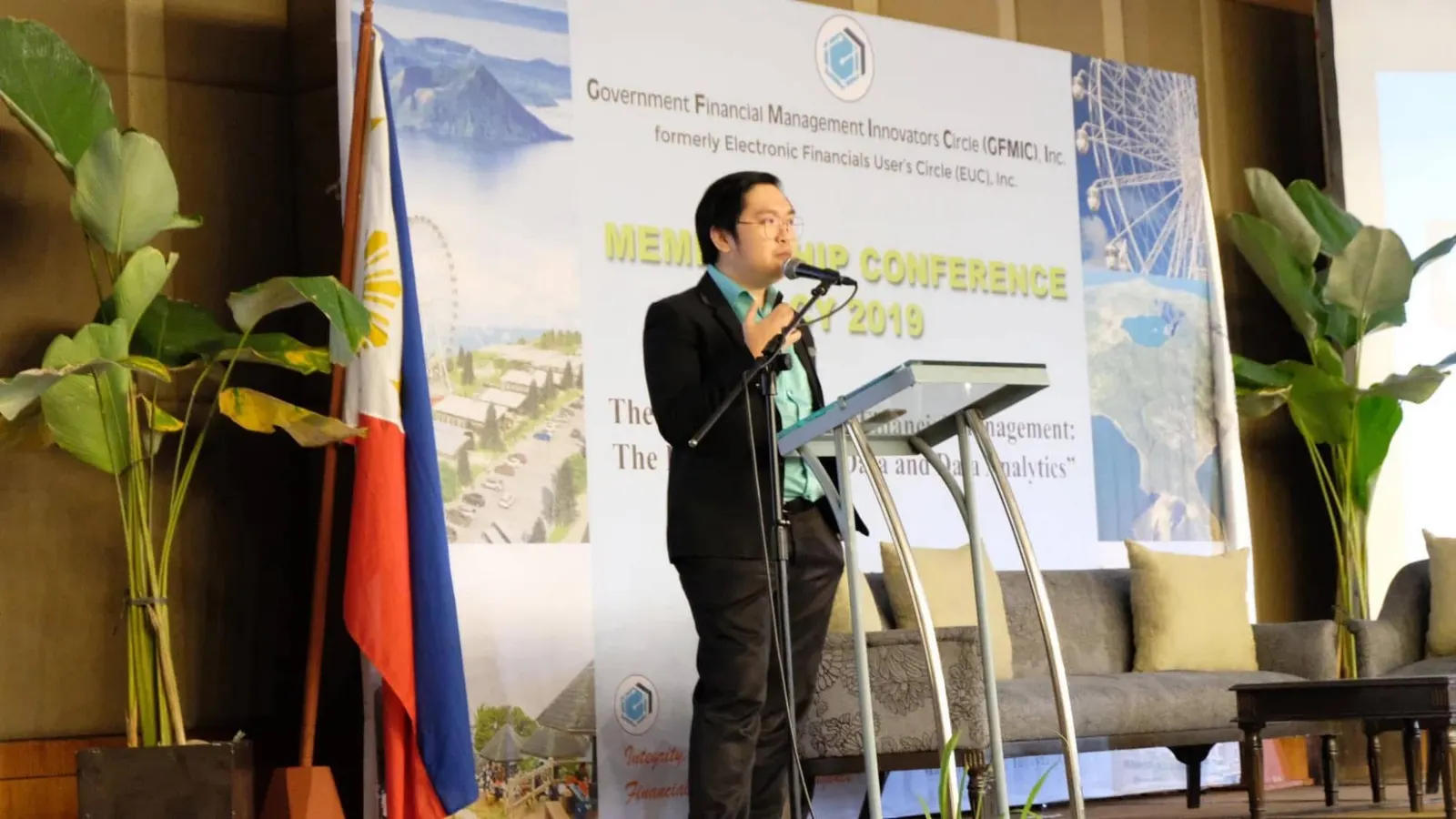
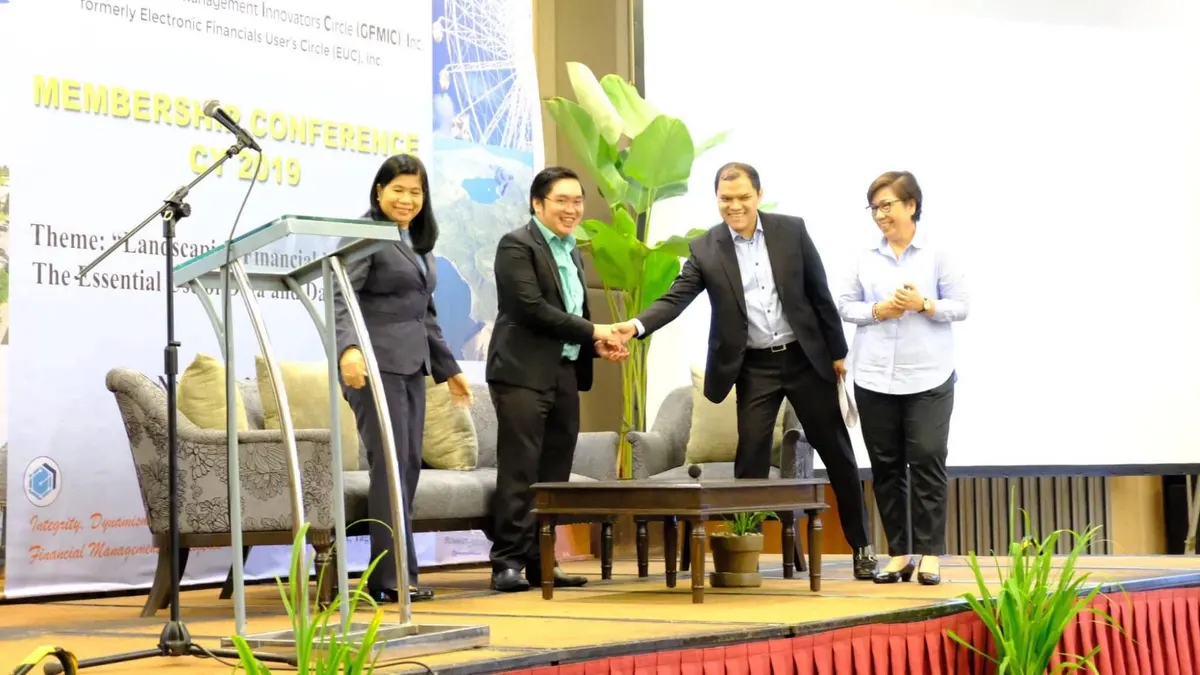
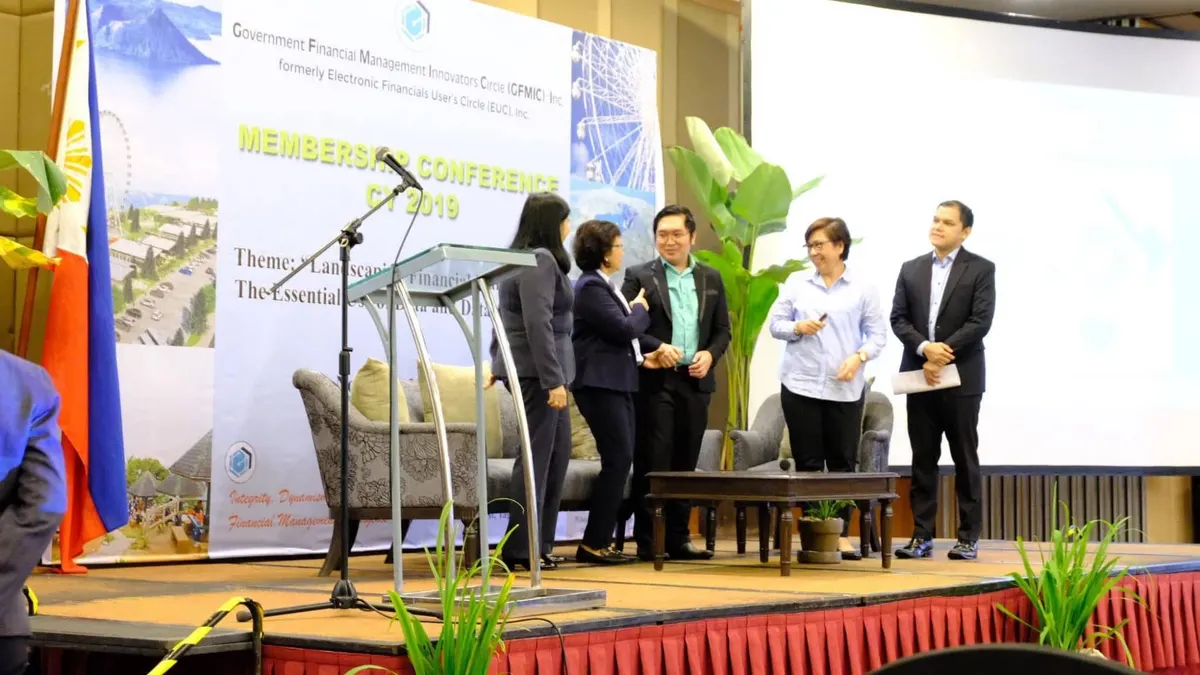
    Consultant

    GFMIC, Inc.

    gfmic.ph

    Start With the Problem

    Not with a spec. Tell me what the day-to-day actually looks like: the spreadsheet, the hand-off nobody wants to own, the system everyone's afraid to touch. You'll get an honest read on whether it's worth building, whether I'm the right person for it, and roughly what it would take.

    What helps in a first message

    • How the process runs today, workarounds included
    • Who does it, how often, and what it costs them
    • What breaks, and what happens when it does
    • What you've already tried or already bought
    • When it needs to be different, and why then

    A few paragraphs is plenty. If it's not a fit, I'll say so and point you at what is.